Polymarket House Odds Still Favor Democrats Midterms
Polymarket House odds still give Democrats about a 90% chance of controlling the chamber after November's midterms, a skew RG.org called a poor Republican long shot.
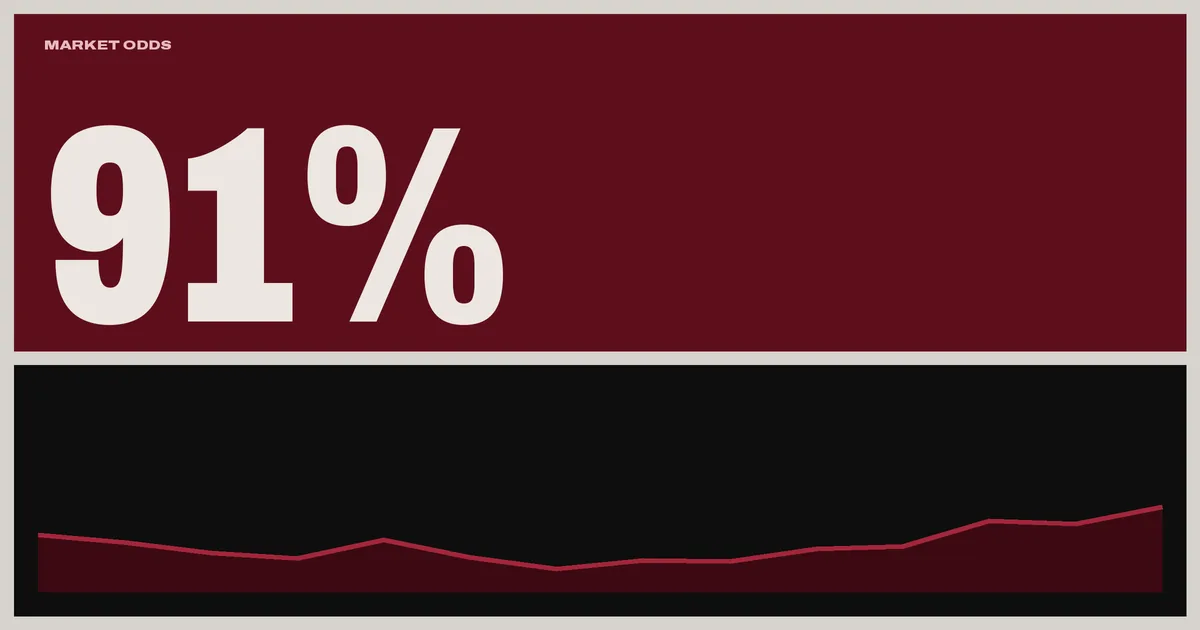
Polymarket House odds continue to price Democratic control after the 2026 midterms as a heavy favorite, even as Fed and crypto boards dominated Monday's tape chatter. The figures above are the overlapping facts confirmed across the cited sources.
What happened
RG.org's Polymarket Daily for Oct. 12 put Republicans keeping the House at about 10% (+900) in a market with $16.4 million traded, calling that long shot poorly priced versus Nate Silver's model (about 6.9% Republican on data to Oct. 8) and a polling average that had Democrats ahead by 7.4 points on the generic ballot. The same roundup listed "Balance of Power: 2026 Midterms" with a Democrats-sweep outcome near 62% and $22.2 million traded, and it put Democratic House control near 91% as the low-return hold. Fed October decision markets led the day's volume commentary at $32.1 million traded with no-change near 84%, but the midterm board is the structural political price.
Live gamma prices for the contract "Will the Democratic Party control the House after the 2026 Midterm elections?" are fetched at build time for the Record call below; as of the Oct. 12 RG.org snapshot, Polymarket House odds and related balance-of-power markets already showed a lopsided Democratic favorite. RG.org also noted Senate odds around 37% Republican in crowd pricing versus a lower model estimate, reinforcing that the House line is the clearer skew.
Why it matters
Polymarket House odds matter for crypto and finance readers because congressional control shapes market-structure legislation, stablecoin oversight, and tax treatment that agency rulemakings cannot fully settle. A 90%-plus Democratic House price does not remove Senate or White House veto points, but it does compress the probability of a Republican House agenda after Nov. 3. Prediction-market depth in the tens of millions of dollars also makes these lines a real-time complement to polls—subject to the usual caveats about concentration, wash flow, and resolution rules.
RG.org's warning against paying up for the Republican long shot is a market-structure comment, not a partisan endorsement. Desk conversations after the print focused on whether the move was a one-session event or the start of a longer adjustment into scheduled data. That distinction matters for how quickly positioning returns. None of the cited outlets framed the episode as investment advice, and neither does this summary; the point is to map what was verified across independent fetches and which calendar dates can change the path.
What's next
Resolution is keyed to the midterm certification window around Nov. 4 on Polymarket's House contract. Watch whether Polymarket House odds compress further after CPI and any late generic-ballot shifts, and whether the balance-of-power multi-outcome market stays aligned with the binary House line. For Called It's Record, the binary Democratic-control contract is the cleanest midterm underlier that is not already booked.
Operational follow-through will show up in whether primary sources update figures, whether companies or regulators issue clarifying statements, and whether secondary markets treat the headline as settled. Until those updates land, the prudent approach is to keep contested secondary claims out of the first account and stick to overlapping facts from at least two independent sources.
The call
Polymarket prices Democratic control of the House after the 2026 midterms at about 90.5% as of 05:28 UTC on 2026-10-13 (volume $9,228,458). We call Yes: the Democratic Party will control the House of Representatives after the 2026 midterm elections. This is a dated record call, not investment or betting advice.
Related: Q3 prediction markets volume and SCOTUS prediction markets. Secondary market reactions can overshoot the operational facts in the first session after a disclosure, which is why this desk separates price moves from the contractual and regulatory steps that actually change user options. Cross-checks between wires remain essential when timestamps differ, especially across New York evening closes and Asia morning opens that describe the same cascade with different last marks.
None of the sources cited here offer investment advice, and this article does not either; the record is limited to verified overlapping facts and dated market prices where a forecast appears. Follow-up coverage will note if issuers, banks, or regulators publish corrected figures that diverge from the dual-source account used in this batch. Positioning into scheduled macro prints can amplify otherwise ordinary corporate or regulatory headlines, so calendar context belongs beside the facts rather than replacing them. Liquidity conditions after a forced-selling episode often look calmer than positioning risk still embedded in options and perpetual futures, which is why open interest and funding deserve a second look beside the spot tape.
This article is for information only and is not investment advice. Calls are editorial forecasts, logged with market odds at the time of publication and kept on the record.