Chip index losing streak sends Nasdaq to worst week
The PHLX semiconductor index fell for an eighth straight session on Friday, its longest slide since 2008, and the Nasdaq lost 4.48% for the week as investors questioned the economics of AI infrastructure.
The chip index losing streak reached eight sessions on Friday, Oct. 16, when the PHLX semiconductor index fell 3.8%, its longest run of declines since 2008, Reuters reported. The Nasdaq Composite dropped 2.15% to 26,140.03 and ended the week down 4.48%, its deepest weekly loss since June, while the S&P 500 lost 1.09% on the day to 7,659.44.
What happened
The weekly damage in chips was severe. The semiconductor index lost 11.4% over five sessions, its worst week since early April 2025, according to Investing.com. Micron fell 14.6% for the week, Samsung 17.8% and SK Hynix 24.3%, while CoreWeave and Nebius each lost 25.2%.
CoreWeave slumped 12% on Friday alone, and its bonds sold off hard enough to push yields above 15%. Broadcom fell 4.5%. Nvidia closed at $214.13, down 1.43%, after trading as low as $213.32, per Stockcharted data. Energy was the best S&P 500 sector, up 2.47%, as oil rose more than 3%.
The Dow held up better, slipping 0.34% on Friday but gaining 0.67% for the week. That gap reflects a rotation out of AI-heavy technology rather than a broad flight from equities, with six of 11 S&P sectors rising on the day.
Other pressures piled on. Reuters said some current and prospective Anthropic investors were weighing a lower valuation for its planned IPO, and Tesla fell 3.1% after unveiling its redesigned Roadster. Volume was heavy, at 18.6 billion shares against a 20-session average of 17.7 billion. Barclays now expects quarter-point Fed hikes in both December and January, while markets increasingly expect no move this month.
Why it matters
The question driving the chip index losing streak is whether AI spending can earn its keep. In an Oct. 14 report, Gartner estimated that data center owners need $8.5 trillion of cumulative revenue through 2030 to cover planned spending and returns, against no more than $3.6 trillion of attributable AI revenue. It put more than $3.5 trillion of spending at risk of impairment and expects over 80% of neocloud providers to stop operating independently by 2030.
Gartner also said AI providers are expected to spend nearly $1 trillion on AI infrastructure this year and another $6 trillion between 2027 and 2030. It sees spending on AI-optimized infrastructure services rising from $66 billion in 2027 to $174 billion in 2030, too slow for most compute providers to recover their investments before the current generation of chips is replaced.
Market breadth shows the concentration risk. The S&P 500 is up about 12% this year, but its median stock has gained only about 6%, and the Nasdaq logged 353 new lows against 51 new highs. The same debt worries have hit CoreWeave's credit default swaps and fed the stagflation scare across risk assets.
What's next
Earnings season now does the arguing. Tesla, Meta and Procter & Gamble report next week, and analysts expect third-quarter earnings growth above 30%, driven by AI megacaps, according to LSEG data cited by Reuters. Comments on capital spending will matter more than headline beats.
Prediction markets see further damage to Nvidia as possible but not the base case. Polymarket's October ladder priced a dip to $192 at about 17% as of 08:30 MSK on Oct. 18. Whether the chip index losing streak breaks will likely depend on what hyperscalers say about next year's budgets.
The call
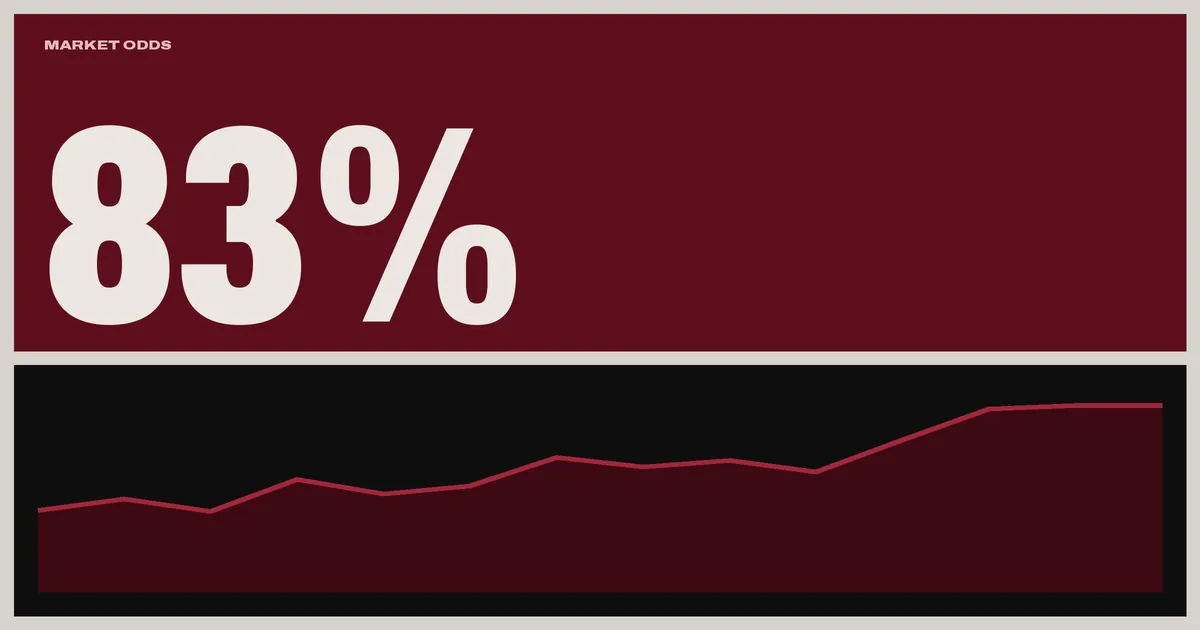
Polymarket prices "Will NVIDIA (NVDA) hit (LOW) $192 in October?" at about 83% No as of 08:30 MSK on Oct. 18; the market settles on regular-hours one-minute lows published by Pyth. We call No: NVIDIA will NOT trade at or below $192 at any point in October 2026. That would take a further drop of about 10.3% from Friday's $214.13 close within roughly two weeks, and the selling has so far hit leveraged neoclouds and memory makers hardest. This is a dated record call, not investment advice.
This article is for information only and is not investment advice. Calls are editorial forecasts, logged with market odds at the time of publication and kept on the record.